AC vs DC Proximity Sensors: Choosing the Right Power for Your Application
Powering Your Detection
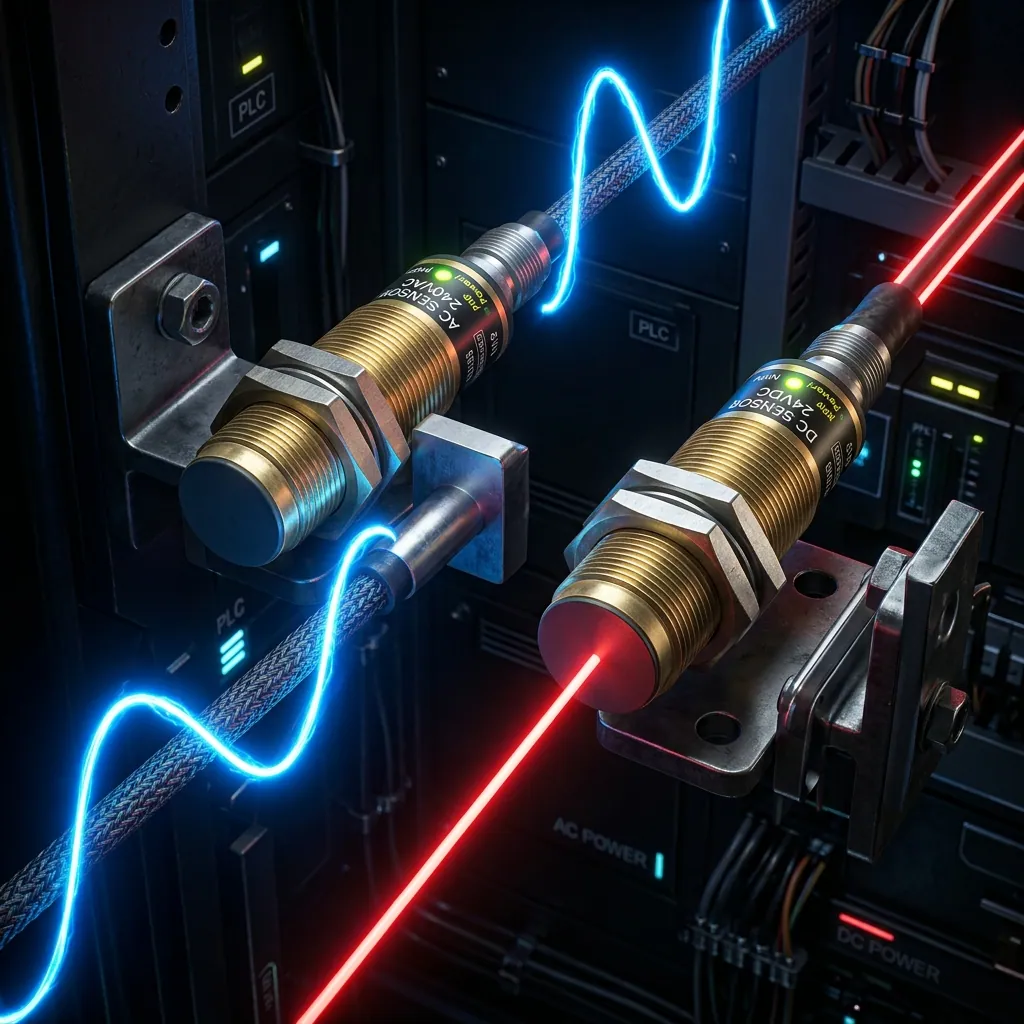
When specifying an inductive proximity sensor, one of the first decisions you must make is the operating voltage type: Alternating Current (AC) or Direct Current (DC).
While the fundamental sensing technology (generating an electromagnetic field to detect metal) is identical, the internal electronics and the way they wire into your system are completely different.
DC Proximity Sensors (Typically 3-Wire)
DC sensors are the undisputed modern standard in factory automation. They typically operate on a 10V to 30V DC supply (24V DC being the universal standard).
How they wire: They almost always use a 3-wire configuration: Power (+V), Ground (0V), and Signal (Output). The output is either NPN (sinking) or PNP (sourcing) to communicate with a PLC.
Advantages of DC Sensors: - High Switching Frequency: DC sensors can switch on and off incredibly fast (up to several thousand Hz), making them perfect for high-speed counting or gear tooth detection. - Safety: 24V DC is a safe voltage for technicians to work with, reducing shock hazards on the shop floor. - PLC Compatibility: Modern PLCs are designed to natively accept 24V DC inputs.
AC Proximity Sensors (Typically 2-Wire)
AC sensors operate on higher, alternating voltages, typically ranging from 90V to 250V AC.
How they wire: They usually use a simple 2-wire configuration. They are wired in series with the load (like a contactor coil or an older AC relay).
Advantages of AC Sensors: - Simplicity in Older Systems: If you have an older machine that runs entirely on relay logic without a DC power supply or a PLC, a 2-wire AC sensor can be dropped directly into the 110V/220V circuit to replace a mechanical limit switch. - High Load Capacity: They can directly switch larger loads (like heavy contactor coils) without needing an interposing relay.
The Drawbacks of AC: - Slow Switching Speed: Because they rely on the 50/60Hz AC waveform, their maximum switching frequency is very low (usually limited to 25Hz). They cannot be used for fast-moving targets. - Leakage Current: Even when "OFF," a 2-wire AC sensor passes a tiny amount of leakage current to keep its internal electronics alive, which can sometimes cause small relays to chatter or fail to drop out.
Conclusion
If you are building a new control panel with a PLC, always use 3-wire DC (PNP/NPN) sensors. They are faster, safer, and industry standard.
However, if you are retrofitting an older, relay-driven machine and don't want to install a 24V power supply, an AC 2-wire sensor is a robust and simple solution.
Looking for reliable industrial solutions?
Explore our catalog of high-quality industrial components manufactured directly in Coimbatore, India.
View Product Catalogarrow_forward