Control Transformers vs. Isolation Transformers: What's the Difference?
More Than Just Stepping Down Voltage
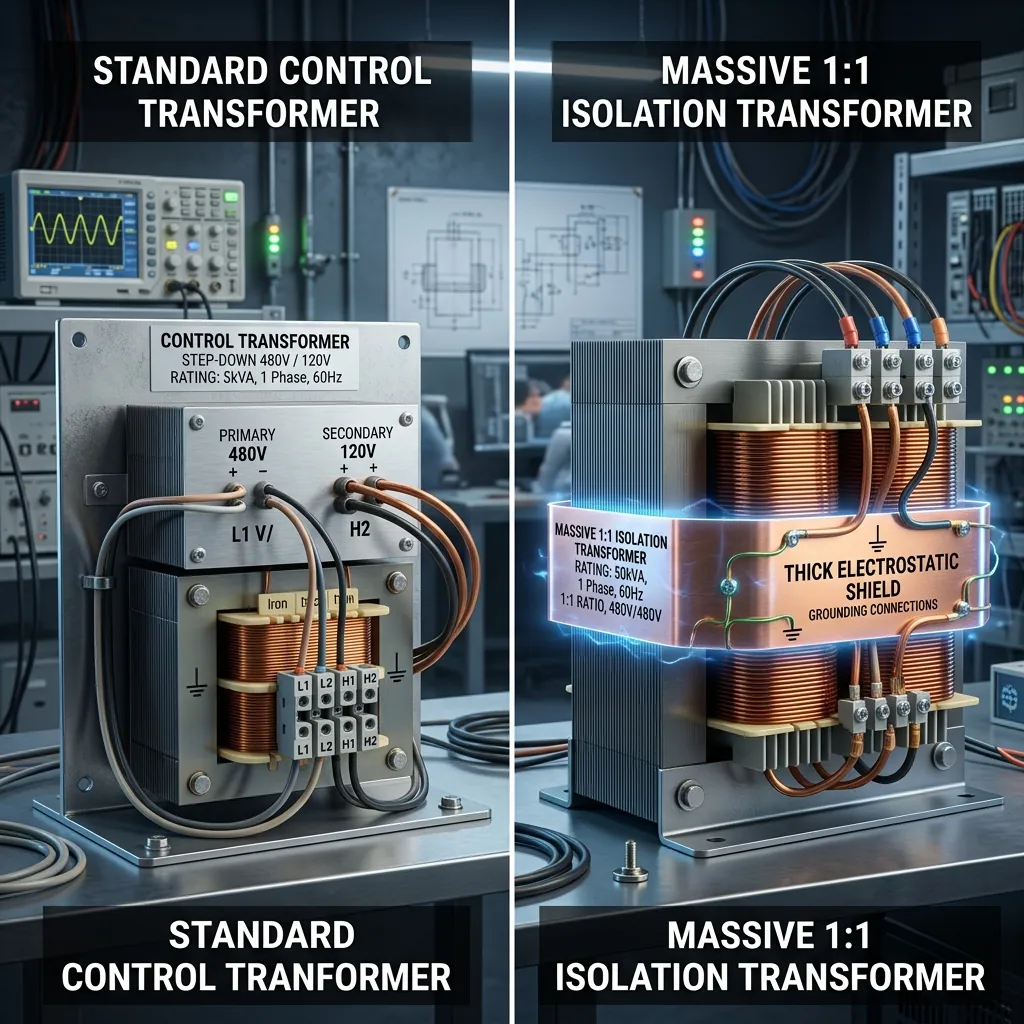
When building an electrical panel, transformers are essential for power distribution. However, engineers frequently confuse Control Transformers with Isolation Transformers. While both utilize primary and secondary coils wound around an iron core, they serve completely different primary purposes on the shop floor.
The Control Transformer
The primary job of a control transformer is voltage step-down.
Factory mains power is typically 415V (3-phase) or 230V (1-phase). It is highly dangerous to run these voltages to push buttons, limit switches, and PLCs.
A control transformer takes the 415V primary voltage and steps it down to a safe control voltage on the secondary side—usually 110V AC or 24V AC. - Goal: Provide safe, localized power for the panel's control circuitry (relays, contactors, timers). - Construction: Built for excellent voltage regulation, meaning the secondary voltage remains stable even when a large contactor coil suddenly draws inrush current.
The Isolation Transformer
The primary job of an isolation transformer is electrical decoupling and noise filtration.
Unlike control transformers, isolation transformers often have a 1:1 ratio. This means if you put 415V in, you get 415V out. So why use one?
Factory power lines are incredibly "dirty." Large motors starting, welding machines, and Variable Frequency Drives (VFDs) inject high-frequency electrical noise, voltage spikes, and harmonic distortion back into the power grid.
If this dirty power reaches the delicate microprocessors inside a CNC machine's controller or a high-end PLC, it will cause random resets, logic errors, or permanent hardware damage.
An isolation transformer physically separates the machine from the factory grid. The power is transferred purely via magnetic flux. - Electrostatic Shielding: High-quality isolation transformers (like those manufactured by Sri Vaarii) feature a grounded Faraday shield between the primary and secondary coils. This shield catches and grounds high-frequency noise spikes before they can reach the secondary side. - Goal: Provide clean, isolated, and protected power to highly sensitive electronic equipment.
Summary
Use a Control Transformer to step down hazardous voltage to power your panel's basic logic relays and contactors safely.
Use an Isolation Transformer when you need to protect expensive, highly sensitive computer equipment (like CNC controllers) from the harsh electrical noise of a heavy industrial factory.
Looking for reliable industrial solutions?
Explore our catalog of high-quality industrial components manufactured directly in Coimbatore, India.
View Product Catalogarrow_forward