Inductive Proximity vs. Photoelectric Sensors: When to Use Which?
The Battle of Detection Technologies
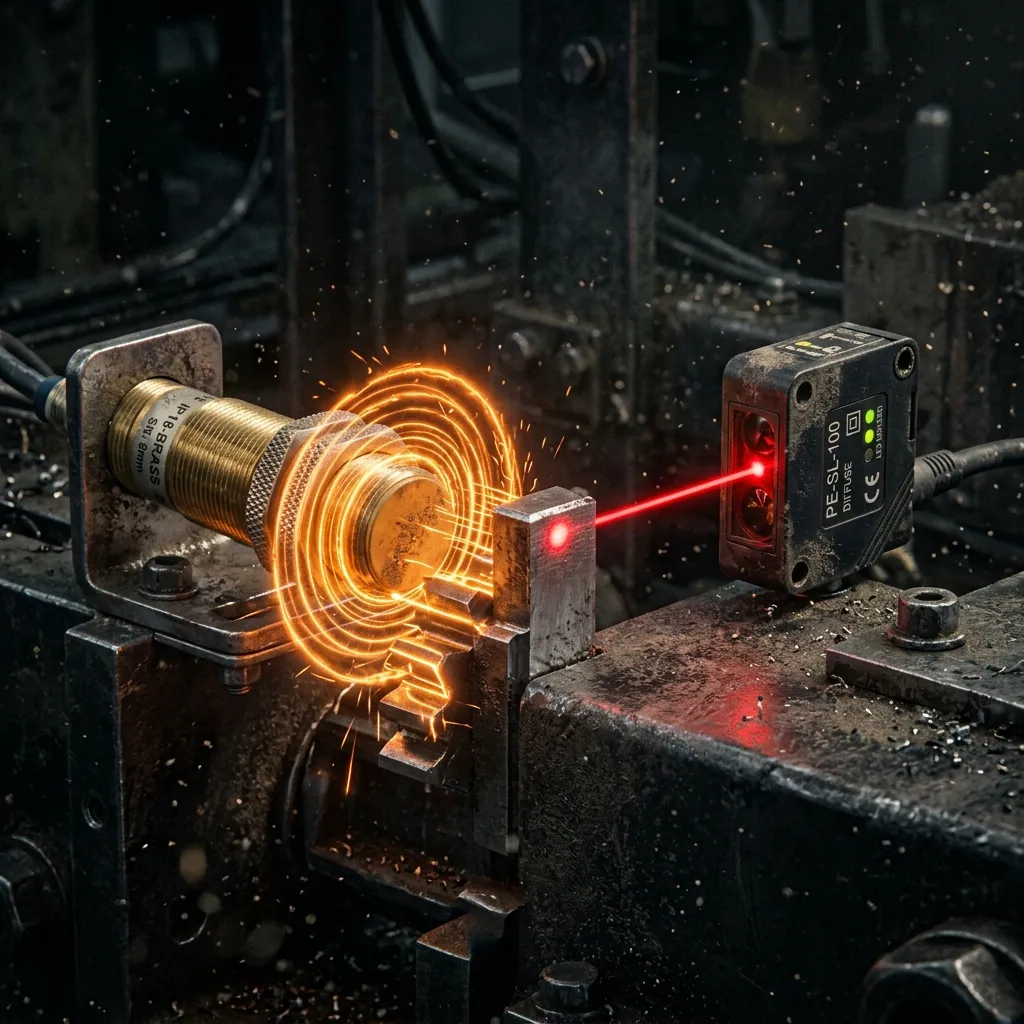
When designing an automated machine, detecting the presence or absence of an object is the most fundamental task. The two most common ways to achieve this without physical contact are Inductive Proximity Sensors and Photoelectric Sensors.
While both achieve the same goal, their underlying technology dictates entirely different use cases. Choosing the wrong one can lead to constant machine downtime.
How They Work
Inductive Proximity Sensors generate an invisible high-frequency electromagnetic field from their sensing face. When a ferrous or non-ferrous metal object enters this field, it induces eddy currents in the target, dampening the sensor's internal oscillator and triggering the output.
Photoelectric Sensors emit a beam of light (usually infrared or visible red laser). They detect objects when the target either breaks the light beam (Through-beam/Retroreflective) or bounces the light back into a receiver (Diffuse).
The Case for Inductive Sensors
Inductive sensors are the absolute kings of heavy industry.
Advantages: - Invincible to dirt: They do not care about dust, oil, cutting fluid, or soot. Since they use magnetic fields, non-metallic contaminants are completely invisible to them. - Extreme durability: Often housed in solid brass or stainless steel, they can take a physical beating. - Vibration resistance: Solid epoxy potting makes them immune to machine vibration.
Limitations: - They only detect metal targets. - Very short sensing distances (typically 1mm to 22mm).
The Case for Photoelectric Sensors
Photoelectric sensors are the masters of distance and material independence.
Advantages: - Any material: They can detect plastic, wood, cardboard, glass, and metal. - Massive range: They can detect objects from a few millimeters up to 50 meters away (in through-beam configurations).
Limitations: - The "Dirty Lens" problem: This is their Achilles' heel. If dust, oil mist, or water droplets cover the sensor's optical lens, the light beam is blocked and the sensor fails. They require regular cleaning in harsh environments.
Conclusion
If your target is metal and passes within 20mm of the sensor, always choose an inductive proximity sensor. It is a "install it and forget it" solution that will last for years.
Reserve photoelectric sensors for applications where you need to detect non-metals (like cardboard boxes on a conveyor) or need to detect objects from far away in relatively clean environments.
Looking for reliable industrial solutions?
Explore our catalog of high-quality industrial components manufactured directly in Coimbatore, India.
View Product Catalogarrow_forward