Understanding Transformer Inrush Current (And Why Your Breakers Keep Tripping)
The Nuisance Trip
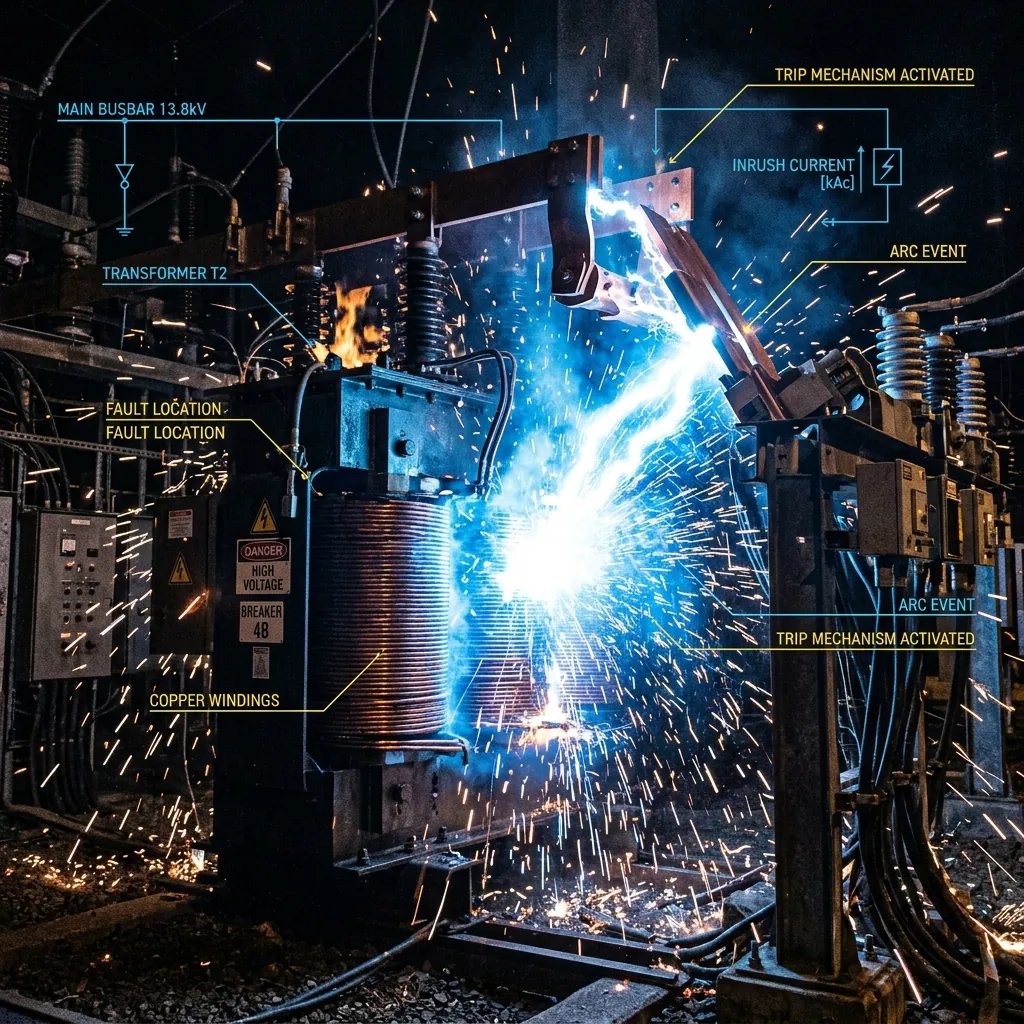
It's a frustrating scenario for any panel builder: You finish wiring a beautiful control panel, you flip the main MCB (Miniature Circuit Breaker) to turn the machine on, and *BAM*—the breaker immediately trips. You check for short circuits, find nothing, try again, and the panel powers up perfectly.
This is the classic symptom of Transformer Inrush Current.
What is Inrush Current?
When you energize a transformer, the iron core is completely unmagnetized. In the very first half-cycle of the AC AC voltage (which lasts just a few milliseconds), the primary coil acts almost like a dead short circuit as it desperately pulls current from the grid to establish the magnetic flux inside the heavy iron core.
This instantaneous surge is called the magnetizing inrush current. Depending on the size of the transformer and the exact millisecond the switch is closed (relative to the AC sine wave), this inrush current can be 10 to 25 times higher than the transformer's normal full-load current.
Why Standard Breakers Fail
Standard "B curve" or "C curve" MCBs are designed to trip quickly to protect wires from short circuits. When a standard breaker sees a current spike 15 times higher than its rating—even if it only lasts for 10 milliseconds—its magnetic trip mechanism engages instantly, killing power to your panel.
How to Solve the Problem
Do not solve this problem by simply installing a massive breaker! If you replace a 5-amp breaker with a 50-amp breaker just to survive the inrush, your transformer is no longer protected against a sustained overload, and it will eventually burn down.
Instead, you must use protection devices designed for high inrush loads:
1. Use Motor Protection Circuit Breakers (MPCB) or "D Curve" MCBs
"D curve" MCBs are specifically engineered to ignore massive, short-duration current spikes (they only trip instantly if the current exceeds 10 to 20 times the rated current). They allow the 10-millisecond transformer inrush to pass through safely while still providing accurate long-term thermal protection against overloads.
2. Use Slow-Blow Fuses (Time-Delay Fuses)
If you are using fuses on the primary side, you must specify "Time-Delay" or "Slow-Blow" fuses. These fuses contain a thermal mass that takes time to heat up and melt. They will happily absorb the massive millisecond energy spike of the inrush current but will melt safely if a modest overload is sustained for several seconds.
The Sri Vaarii Advantage
At Sri Vaarii Automatiion, we design our transformer cores with high-grade CRGO (Cold Rolled Grain Oriented) steel. While inrush current is an unavoidable physical phenomenon in all transformers, our high-quality core materials and precise winding calculations help optimize flux density, making the inrush surge more predictable and easier to manage in your panel designs.
Looking for reliable industrial solutions?
Explore our catalog of high-quality industrial components manufactured directly in Coimbatore, India.
View Product Catalogarrow_forward